
Turn customer stories into AI driven design workshops
-
With customer storytelling, we can begin each design session with a compelling video of a customer story. Turning our design thinking into an investigation.
-
With our AI Innovation Chatbot, we can bring our customer to life. Our AI doubles as the voice of our customer and also as our Innovation consultant, helping us to develop our process of innovation.
-
With our 50 step-by-step facilitation strategies, we can validate our customer story. Use the customer story video in a powerful brainstorming session, and finally, prototype and test the best solutions.
-
With customer storytelling we can collaborate around customer stories to design future markets.
The Perfect Design Toolset
It's called The Design Tree; turn customer stories into interactive design thinking workshops. Find your product-to-market fit faster, create insane value propositions, and brainstorm feasible and innovative ideas. Collaborate with a community of entrepreneurs to design future markets and economies.
Interactive A.i. Guided Workshop
The Design Tree transforms static research into a live, interactive strategy session. As you watch a compelling video of a customer story unfold, our A.i Innovation Co-Pilot works alongside you—answering questions, uncovering hidden friction points, and guiding your team through high-impact brainstorming. It’s an immersive experience built to challenge your assumptions, unlock breakthrough ideas, and accelerate product to market fit.
A Story is the Perfect Prompt
We’ve paired this advanced customer storytelling framework with 50 step-by-step facilitation strategies and an A.i. Chatbot that doubles as your Virtual CoFounder/Innovation consultant, guiding you or your team into design thinking, checking your work, analyzing your results, and giving substantive feedback, as you progress from the early idea to accelerated business revenue.
A.i. and Human Collaboration
Empower your facilitators with an A.i Virtual Co-Founder that actively sharpens workshop outcomes in real time. Beyond simply automating workshop data, the A.i Co-Pilot continuously audits progress, stress-tests ideas, and challenges internal biases as teams move through ideation. It acts as an elite innovation consultant embedded in every sprint—giving facilitators the data, rigor, and high-tech edge needed to deliver bulletproof strategies directly to executive leadership.
The Design Tree Toolset
-
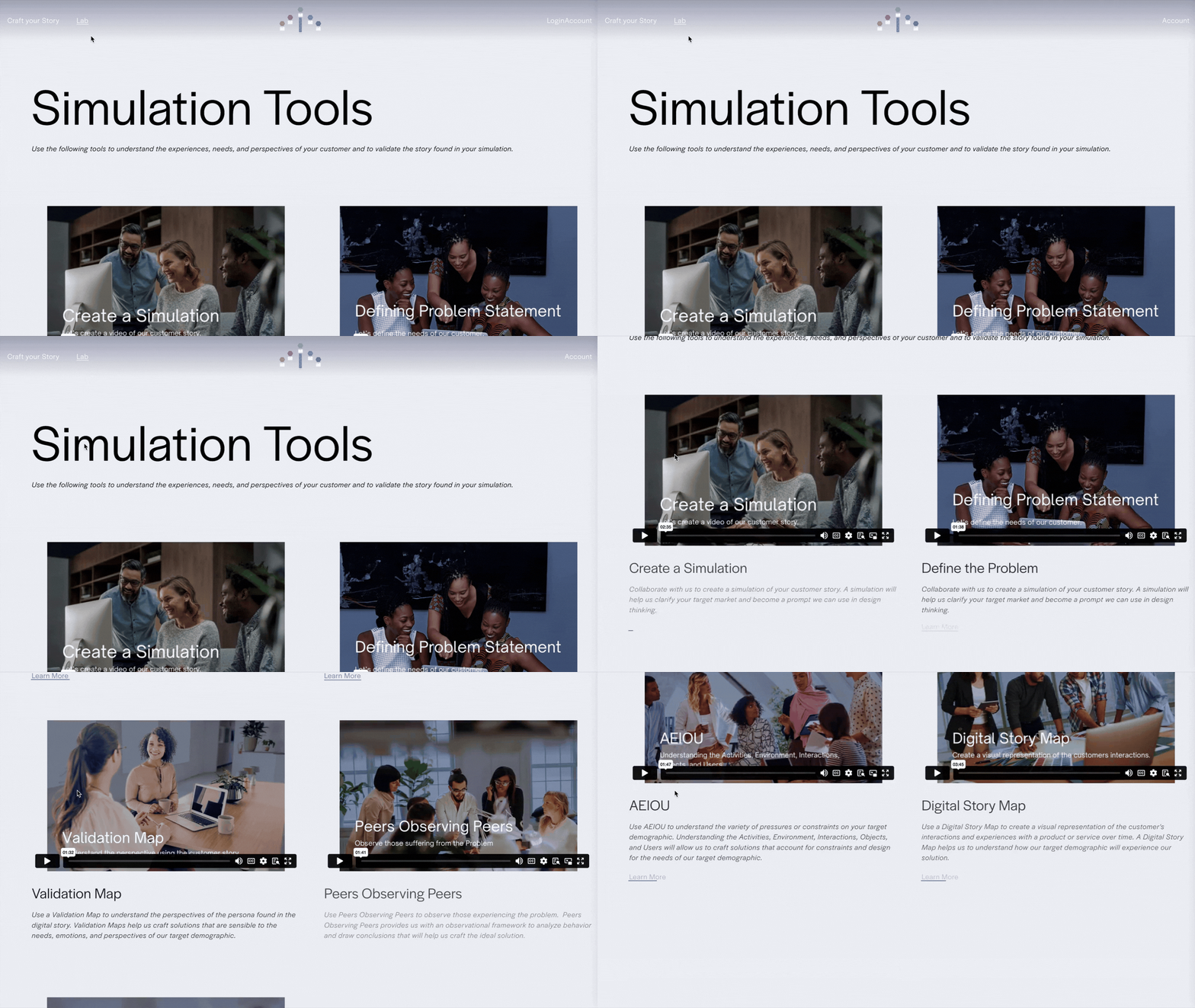
Simulation Tools
Craft your Story
Humanize the story of your customer. Document your customer as they move through time experiencing aspirations, frustrations, and finding the motivation to continue. Our digital story will help us explore and understand our customer and craft the ideal solution that fits seamlessly within their human story.
Define the Problem
Collaborate with us to create a simulation of your customer story. A simulation will help us clarify your target market and become a prompt we can use in design thinking.
Validation Map
Use a Validation Map to understand the perspectives of the persona found in the digital story. Validation Maps help us craft solutions that are sensible to the needs, emotions, and perspectives of our target demographic.
Peers Observing Peers
Use Peers Observing Peers to observe those experiencing the problem. Peers Observing Peers provides us with an observational framework to analyze behavior and draw conclusions that will help us craft the ideal solution.
AEIOU
Use AEIOU to understand the variety of pressures or constraints on your target demographic. Understanding the Activities, Environment, Interactions, Objects, and Users will allow us to craft solutions that account for constraints and design for the needs of our target demographic.
Digital Story Map
Use a Digital Story Map to create a visual representation of the customer's interactions and experiences with a product or service over time. A Digital Story Map helps us to understand how our target demographic will experience our solution.
User Participant Group
After creating your digital story organize a user participant group. A user participant group is a collection of people who mirror the persona found in your digital story. Use your user participant group to validate or invalidate your digital story.ription text goes here.
-
Interview for Empathy
Use to understand users' perspectives, needs, and emotions through meaningful conversations. Interview for empathy is a framework for conducting and interview with our target market/customers to obtain and understanding of their perspective needs and emotions.
Explorative InterviewUse to gain new insights, ideas, and perspectives of those experiencing the problem. An Explorative Interview is an interview framework that involves asking a series of open-ended questions to gain an understanding of how our target demographic experiences the problem.
Simulation Survey
Use a Persona Validation Survey to validate our representation of those experiencing the problem found in the digital story. Personas help us craft solutions that align with our target demographic.
How Might We Question
Collaborate to create the correct problem statement through an open-ended exploration of a wrong and right problem statement. How Might We Question is a problem framing tool to develop the right problem statement.
Vision ConeUse the Vision Cone to design a future outcome. A Vision Cone works by imagining a new future and crafting actionable steps to arrive at the new vision. A Vision Cone can reinterpret the problem and discover new market opportunities.
Storytelling
Collaborate to create a narrative around those experiencing the problem. Storytelling engages our target demographic to define the problem through their statements and to craft a solution that addresses their needs.Critical Items Diagram
Use to identify and prioritize key elements or factors for successful problem-solving. A Critical Items Diagram helps us brainstorm key experiences and functions leading toward crafting an innovative solution.
Context Mapping
Use the Context Map to understand the perspectives, needs, and behaviors in their social and cultural context. A Context Map helps us craft solutions that are conscious of our customers social and cultural context.
User Participant Group
After creating your digital story organize a user participant group. A user participant group is a collection of people who mirror the persona found in your digital story. Use your user participant group to validate or invalidate your digital story.
-
Brainstorming
Use to generate ideas without judgment or evaluation. Brainstorming is a creative ideation technique that uses brainstorming guidelines to generate future solutions to a problem.
Analogies & Benchmarking
Collaborate and draw inspiration from existing products, experiences, or industries for innovative problem-solving. Analogies and benchmarking can help us to generate out of the box ideas to solve our target markets problem.
Special Brainstorming
Use for unconventional brainstorming to obtain new ideas or insights into a problem. Special Brainstorming helps us to reframe our thinking to craft new solutions.
Brainstorming Session
Collaborate with your team reflect on your digital story and brainstorm solutions to empower the persona to overcome the problem. Finally, develop an elevator pitch detailing the solution.
2x2 Matrix
Use to create a criteria to categorize ideas or options based on two values or criteria. A 2x2 Matrix can help us determine which solution maybe more beloved by our target market.
AEIOU
Use AEIOU to understand the variety of pressures or constraints on your target demographic. Understanding the Activities, Environment, Interactions, Objects, and Users will allow us to craft solutions that account for constraints and design for the needs of our target demographic.
Digital Story Map
Use a Digital Story Map to create a visual representation of the customer's interactions and experiences with a product or service over time. A Digital Story Map help us to understand how our target demographic will experience our solution.
-
Prototyping Tools
How it Works Prototype
Collaborate with your team to construct a visual representation of an idea from your brainstorming session. Then, devise a brief marketing strategy to discover the solution. Lastly, provide an explanation of how the solution works in three sequential steps or list three important features.
Minimum Viable Product
Use to create a version of a product with core features to test the solution’s ability to solve the persona’s problem. An MVP helps to gather value feedback to create the ideal solution.
Prototype to Test
Use to document how the persona experiences the idea or prototype and its prototype variants. The Prototype to Test helps us to assess user needs and acquire important feedback.
Pitch Deck
Use to create a presentation that succinctly communicates a product, service, or idea to stakeholders or investors. Pitch decks help others to understand, care, and take action in championing our solution.
Testing Tools
Testing for ValidationUse to craft a series of quantitative and qualitative questions to gain insight into how your solution is solving or failing to solve the persona's problem.
Testing SheetUse to plan, execute, and record observations testing your solution. The Testing Sheet helps to ensure your prototype is meeting the needs of your users.
Solution Interview
Use to gather feedback and insights on a solution. The Solution Interview helps us to test if our solution is accepted by our target demographic.
Exploration Map
Use to gain new insights, ideas, and perspectives about those experiencing the problem. An Exploratory Interview helps us to understand our target demographic so we can address their needs through our solution.
Design Thinking Plan
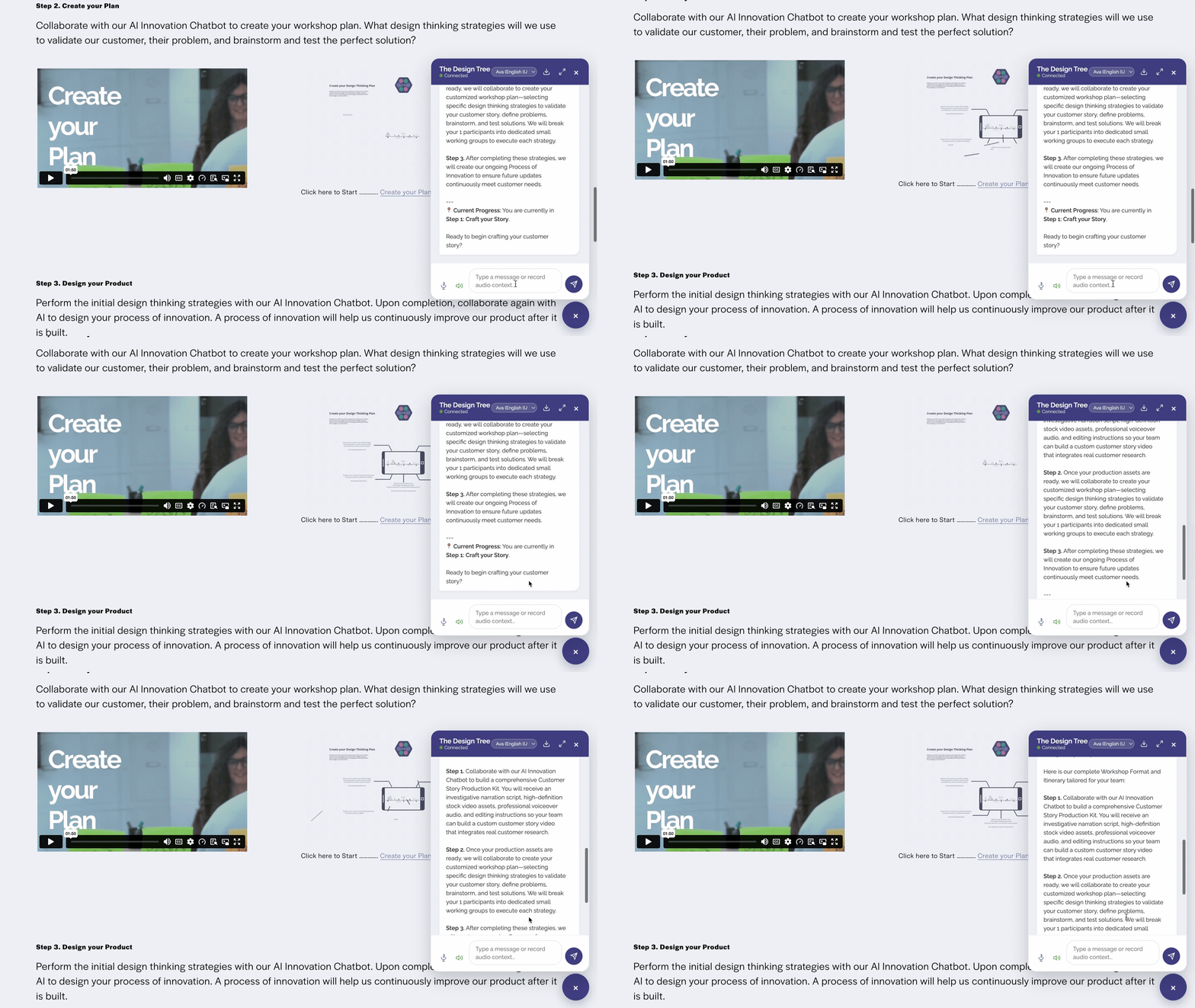
Create a design thinking plan a list of design thinking strategies you can perform to validate your digital story and develop and test your solution.
Complete Digital Storytelling
Update your digital story with the information from the ideation, prototyping, and testing phase and other design thinking experiments that validated or invalidated your persona and their affinity for your solution. This powerful visualization helps us to explore our alleged persona's journey and refine our solution and user experience.
Digital Storytelling Cross-Collaboration
Our digital story once completed is the perfect repository for our user research and with this user research we can co-create and cross-collaborate to design a suite of products and services, or collaborate to solve systemic issues, or work together to build new ecosystems and even collaborate overtime with stakeholders, our government, businesses, civil society and the public to build a new economy.
2x2 Matrix
Use to create a criteria to categorize ideas or options based on two values or two criteria. A 2x2 Matrix can help us determine which solution maybe more beloved by our target market.
NABC
Use as a framework to articulate the Need, Approach, Benefit, and Competition of a proposed solution or concept. NABC can help us craft a solution that will be embraced by our target market.
Analogies and Benchmarking
Use to draw inspiration from existing products, experiences, or industries for innovative problem-solving. Analogies and benchmarking can help us to generate out-of-the-box ideas to solve our target markets problem.
Service Blue Print
Use to create a visual representation of a service's, customer interactions, and underlying processes to identify areas for improvement. The service blue print will allow us to create the ideal user experience.
Exploration Map
Use to create a visual of various paths, possibilities, and potential solutions for a problem. The exploration map helps us to rate and evaluate the various prototype the variety of solutions that can solve the problem.
Feedback Capture Grid
Use to organize and analyze feedback received from users or stakeholders during a design process. The Feedback Capture Grid helps us to analyze if our solution solving our target demographics problem.
A/B Testing
Use to compare two versions of a product or solution to determine the more effective option based on user responses. A/B testing help us determine which version of our product our target demographic likes the most and why.